


History
Brandauer’s capabilities and expertise are backed up by over 160 years of history, but what does that history and journey look like?
After being founded in 1862 and staying a family business until September 2025, let’s take a look at some of this amazing historical journey and how changing times, worldwide events, and internal innovation have shaped Brandauer into the business it is known as today.
Our History
Many long-established firms in the UK owe their existence to ancestors who came to this country as immigrants, and Brandauer is no exception. We were founded by a citizen of the German Kingdom of Württemberg, with support from an Austrian and the grandson of a Frenchman who had fled to London in the 18th century to escape religious persecution.
Although the company bears the Brandauer name, the company actually began with a Frenchman, Jean Petit, born in Northern France in 1748. After his migration to Birmingham in 1785, he was working as a ‘Toyman’ in High Street, about 0.5 miles from where the Bullring currently stands today. We know that Jean Petit was married in 1786 at St Peter’s Church in the village of Harborne, which was then part of Staffordshire, and that he and his wife Elizabeth had six sons. It was the fifth and longest surviving of these, Francis Petit, born in 1794, whose son Joseph Letière Petit was to become a toolmaker in the pen trade and help to start our family business.
Joseph Letière Petit began his career in Birmingham as a toolmaker and had his first patent for a steel pen nib submitted in 1860, which led the toolmaker to begin manufacturing pen nibs under the name Ash, Petit & Co.
It’s at this stage of the story that Karl Heinrich Immanuel Brandauer comes in. His father, at the time, was acting as Ash, Petit & Co’s agent in Vienna and after supplies from Birmingham began to slow down, he sent his son to investigate.
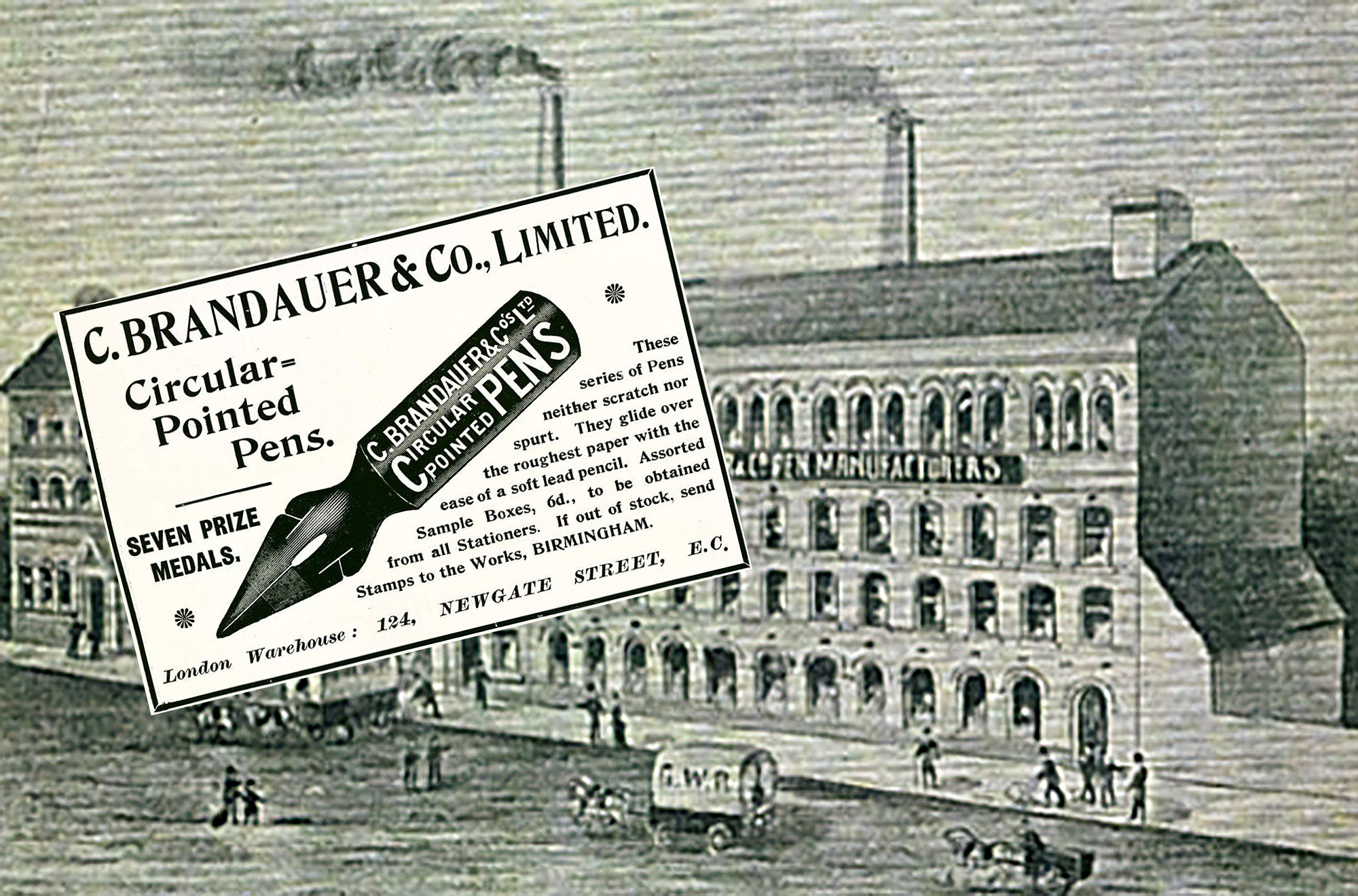
Karl was clearly impressed with the work going on in Birmingham, and he soon agreed to finance a new factory in the centre of the city of Birmingham. In August 1862, the Birmingham Journal announced that C. Brandauer & Co. Ltd had moved into its new premises, and that’s where the Brandauer we all know today began.
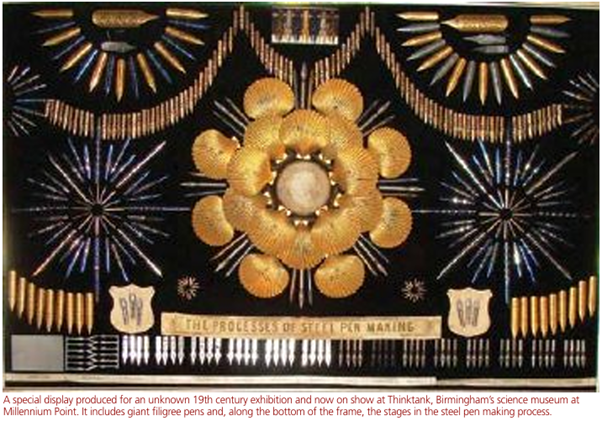
Steel arrived from Sheffield, delivered from the good station by horse-drawn wagon. They were in narrow sheets which were then cut into strips, which were then heated and cooled for 18 hours to make the steel easier to work with.
Once the steel reached the desired temperature, they were “pickled” in sulphuric acid and water, where they were then placed in revolving cylinders filled with small stones to remove the surface scale, leaving the steel bright and clean.
The finished strips were taken into the warehouse where they were quality checked and stored before they were needed. The next stage involved cutting the “flat blank” (something Brandauer still does every single day all these years later) from the steel strip. These were then taken to piercing, making the hole which would hold the ink when dipped into the inkwell. It has been noted that a skilled operator would be able to pierce around 75,000 blanks a week!
After another heat treatment, the blanks were stamped with the Brandauer name (or sometimes for the customer of whom they were being produced). This was done with a foot-operated press to ensure both hands were free from the press when stamping took place.
The next stage is raising the flat blank. This created the rounded shape of the finished pen, before another round of heat treatment hardened the steel. After heating until red hot, the pens were plunged into cold whale oil, making them hard but brittle, easily snapped in half. Once cleaned, they were put into barrels containing fine stone grit, which, after several hours of shaking, made the pens smooth and bright! After one final polishing in sawdust barrels, they were sent off to tampering.
Tampering contained yet another heat treatment that produced a flexible but tough pen nib. They moved to a grinding room where the thickness of the pen was reduced by a few thousandths of an inch to make it more flexible. The final stage was the most delicate process of all, creating the crucial slit that would turn the pen into a precision writing instrument.
Once all the steps were completed, they were taken for a final inspection. Inspectors were looking for possible defects in the shape, piercing, slitting or marking of the pen. If 36 or more pens were found with any particular fault, these were taken back to whoever was responsible in that department and the exact value was deducted from their wages! The collected wages throughout the year were used to pay for a works outing for everyone in the summer. So, not all doom and gloom!
Today, when you pick up a pen to write with, they are usually very similar; it’ll more than likely be a ball-point or felt-tip pen. You also probably don’t give much thought to what it looks like or whether it will suit their writing style. But, back in the 1800s, it was completely different. Writing was the main form of communication back then so ensuring you had the perfect pen for the job was a very serious decision.
So important in fact, by 1890, Brandauer’s catalogue of pen nibs contained no fewer than 424 individual pen designs! All in different shapes and sizes, some with elaborate embossed images and other decorations. Many of these designs were also available in a choice of colours, widths, hardness and flexibilities. There were pens with more than one point, pens produced specifically for use with handmade paper, and pens for schools and offices. To put it simply, there was a pen design for every person in every type of scenario.
Brandauer’s most famous pen nibs were the ‘times’ and the ‘mail’ nibs, named after the daily newspapers. Their popularity mainly came from the consistent advertising Brandauer partook in. These pens were advertised on trams, buses and even the London Underground. Alongside this, the box design was of huge importance, with some designs including pictures of the famous people after who the pens were named, and special boxes were even designed for overseas markets such as Japan.
Even back in the 1800s, exhibitions played a key role in Brandauer’s promotional strategy, attending many exhibitions worldwide and in the UK. Back then, trade shows and events attracted well over two million people!
By the end of the Victorian era, Brandauer pens were in everyday use throughout Britain, from the Rothschild family (the richest in the world), to the humblest worker in Birmingham. They were used vastly in schools, government offices and banks, by lawyers and mapmakers, in different shapes and sizes, exported around the whole world. Brandauer pen nibs were some of the world’s most famous, and that remained throughout the 20th century. Troubles in world politics were going to make some key changes in Brandauer’s historical journey.
During the First World War, Brandauer aided in war efforts by manufacturing components for the Lee Enfield rifle. This was one of the first times Brandauer contributed to manufacturing metal components outside of pen nibs.
During the time between WW1 and WW2, it was documented that Brandauer experimented with “light pressings” around the factory, as it was documented that post WW1 manufacturing output declined sharply, and the situation worsened with the worldwide slump after 1929. Brandauer had always concentrated on the quality end of the pen market and the international export trade, with agents all over the world, from South Africa to Turkey, India, Scandinavia and South America. Pens were specially designed for some countries, such as Japan. However, as more became self-sufficient, some of the most profitable businesses began to decline.
The Second World War broke out, and many plans were put in place to ensure Brandauer could continue with operations. By 1942, the Government’s Manpower Board declared “the manufacture of steel pens and stationers’ sundries to be non-essential work, directing the transfer of all labour engaged in the production thereof to essentials of war”.
Brandauer engaged in many differing outputs and methods to keep the factory busy and help with the war efforts, with the most notable being the Air Ministry already approving C. Brandauer to produce aircraft parts, mostly due to the earlier work the company completed for Lockheed Hydraulic Brake Company. This gave Brandauer an opening to produce a huge range of components for various aviation applications, including needles for gauges, rivets and roller cages for undercarriage bearings. It is also believed that components went onto the world-famous Spitfire! Production continued, and it was documented that press machines were specifically bought to complete work described as “aeroplane work”.
Post-war Britain was not kind to C. Brandauer & Co. Ltd. Labour shortages and the poorly timed winter of 1946-1947 made the situation quite difficult for Brandauer to operate normally. Power cuts were present, and by January, a lack of coal supply to the business caused issues with the heat treatment operations.
Manufacturing continued with struggle, and it was in April 1953 that chairman Russell Petit was forced to acknowledge that penmaking was a “largely redundant trade”, and going into the 60s, Brandauer’s presence in the penmaking industry began to slowly phase out.
Although the economy was in a recession and the impact on the business was still showing, presswork sales were increasing with customers from a variety of sectors, ranging from parts for GKN Screw Division, hinge springs for Joseph Lucas, and even components for Birmingham Sound Reproducers (BSR).
BSR became a huge customer for Brandauer during this time; they produced manual and automatic turntables and changers for record players, and at its peak in 1977, BSR were producing 250,000 units per week. This was thanks to their over 85% market share in producing auto-changers for all the world’s leading record player manufacturers.
Brandauer manufactured switch inserts, cartridge contacts, flat stylus arms and many other assembled components which went into BSR products.
It was in May 1964, with the announced retirement of Major Harold Rushton, that the biggest pivot in Brandauer’s strategy. Family member Joseph Letière Petit (more commonly referred to by his second name Adrian/Ian) was to change Brandauer’s approach massively, bringing a more professional approach that was to lay the foundations for how the business runs today. He began working at C. Brandauer in 1938 and chose to go to university after the Second World War had ended. He then worked as a Progress Manager in 1946 and studied Mechanical Engineering in Nottingham from 1948 to 1951.
He became director of the company in 1958 and shared his great-grandfather’s talent for invention. In 1972, he created a simple self-adhesive clip for securing cables and many other uses that are still being manufactured (and now owned fully) today by Brandauer! (See Brandauer cable clips for more information).
Adrian was also the director who saw the end of the 103-year trade of manufacturing pen nibs. It was a sad moment for the company, but not all was lost! More Schuler power presses were being purchased to meet the growing demand from Honeywell, BICC, IBM and Bonella, all of which solidifying the post pen-nib growth was in full swing.
This era for Brandauer was a very diverse time and set the tone for the decades to come, with components being manufactured for civil and military aircraft being made right next to components that went into Singer sewing machines!
The 70s and 80s brought huge developments in technology, which gave Brandauer huge opportunities. Just like BSR did, this industry boom created entirely new products and processes.
One of the most notable successes for Brandauer in this era was during the growth of personal and home computers, more specifically, in floppy disks! Brandauer has proven their excellence in manufacturing high-quality components in vast quantities, and the hubs and shutters for computer floppy disks were an ideal product for the company. By the early 1990s, the increasing size of many software packages required a dozen disks or more. In 1996, it was estimated that there were at least five billion floppy disks in use. Production of floppy disk shutters began in 1989, followed by hubs in 1991, of which more than half a billion were made.
Modern manufacturing standards became a key talking point at Brandauer, and in January 2001, a move was finally completed to move all work to a new factory (just 200 metres away from the previous factory) on Bridge Street West, and is still the home of Brandauer today. This move made a huge change, and it was left to wonder why this move didn’t happen sooner! Just before the move, you could still see old belt driven systems in the ceiling which were used back when the factory ran on steam power.
Projects and collaborations were still thriving for Brandauer, with different projects and manufacturing techniques becoming more and more common within the factory.
Some notable projects of recent times are: Brandauer’s development and manufacturing of grab rings of various different shapes and sizes, continued growing development in razor blade stamping, and a huge job working with CERN on components that went into the hadron collider!
This brings us onto the future and beyond, with a huge historical shift in the company. In September 2025, for the first time in the company’s vast history, ownership transferred from the founding family into new hands: a management buyout (MBO) was completed by the company’s current CEO Rowan Crozier MBE, Manufacturing Director Stuart Berry and Non-Executive Director David Chapman. A 10-year development plan has been put in place to help take the business to the next stage of its life and plans are already underway to ensure this development plan is delivered. Huge contracts in the automotive sector were secured just a couple of months after the MBO was completed.
Who knows what lies next for Brandauer? New industries, capabilities, innovations and culture are all going to be huge parts of the journey the company will continue to go on in the future. One thing is for sure: Brandauer will continue to work with customers to provide the highest quality precision components the world has to offer, all of which is backed up by over 160 years of incredible history.
Nationally recognised,
globally trusted
Beyond heritage and case studies, Brandauer has a reputation backed by a range of awards and quality standards. Along with being one of the very few SMEs to hold both the King’s and Queen’s Awards for International Trade and Innovation, the business has also been a proud recipient of multiple awards over the years, all in many different areas, spanning components, people and environmental efforts!
Beyond Brandauer’s success, we hold a range of quality certifications and are committed to continuous improvement of everything we do.






The latest from the Info Hub
Industry insights, technical guidance and knowledge sharing from Brandauer, global leader in precision high-volume engineering.


