


On this page
What is metal stamping?
Advanced manufacturing is a game of numbers, and it’s all the same with precision metal stamping. But what is metal stamping?
To put it simply, it involves a thin piece of sheet metal, found in either a blanked or coiled form, fed through a power press machine continuously. Within that machine, there is a tool which consists of multiple sets of punches and dies. These elements come together to cut out and/or form the desired shape.
That is metal stamping in its most simple form, but as you might expect, there is a lot more to it than this. This article will be the complete guide to precision metal stamping, grasping at the generalised processes, Brandauer’s specialities, where we excel and finally, how data capture, a scalable approach to process, Design for Manufacturing (DFM), pivoted learning and collaboration. All lead to a high-value technical stamped component.

Metal stamping buzzwords
Before we get into a more thorough analysis on precision metal stamping. Let’s make sense of the various terminology you may come across when working within this industry:
| 1. Micron: A micron is a unit of measurement. To be specific, a micron is one millionth of a metre, and to put that into perspective, a human hair is about 50 microns thick. A newspaper? 100 microns thick. Brandauer works within tolerances on our metal stamped components of up to 20 microns (or 0.002cm). That is the same thickness as the average piece of aluminium cooking foil! | 5. Piercing/punching: This process is very similar to blanking. A tool is used, and a punch & die come together to stamp out a metal part. The key difference is the material that is punched out is considered the scrap metal, and any remaining material is used as your product. You will find piercing most commonly being used in reel-to-reel metal stamping. |
| 2. Tooling: Tooling is the specialised (bespoke) contraption that creates the cuts, forms and shapes to the sheet metal when it is being fed through the power press machine. They usually consist of a punch & die that close together to create the desired metal part. They are separate from the press machine itself and add huge value to the customer, as it’s an owned asset. You can read more about Brandauer’s tooling capabilities through this blog post. | 6. Forming: Forming is the manufacturing process of reshaping sheet metal without removing any material. Forming permanently deforms the metal into a desired shape without disrupting the mass and volume. You can form a metal part in one of several ways, with DFM and design collaboration, you can take a part and create simple forms or bring it to a complex manufacturing process, which includes multiple forms within a singular part. |
| 3. Punch & Die: The punch & die are key working parts of the tool; the die is the bottom section of the tool, and the punch is the top section of the tool. A punch is the moving part within a tool, and it is “punching down” on the metal to create the cut/form. The die is there to support the material and provides the shape for the resulting hole or form created. | 7. Bending: Bending is a sub-category within metal forming. It’s the process of deforming a piece of metal along a straight line to create an angle, specifically a V, U, or channel shape. An example of bending is shaping a piece of metal into an “L” shape with a 90° bend. |
| 4. Blanking: Blanking is the metal stamping version of a cookie cutter. It’s the process of precisely cutting a product from sheet metal. The punch & die from a tool come together and a desired shape is punched out – that is your product. The rest of the material is treated as scrap or waste. | 8. Coining: Coining is a finishing stage of the manufacturing process. It adds fine details to the surface of a piece of metal, some examples include sharp lines, textures, or raised/engraved patterns. The name originates from coin making, but it can be used for a variety of parts. It requires great precision and is performed without heating, with no lubrication and requires a lot of force to complete. |
What are Brandauer’s specialties?
Metal stamping is a big industry with continued growth expected in the long-term. Brandauer prides itself on excelling in certain key areas of precision metal stamping manufacturing.
Thin-gauge metal stamping
Brandauer believes the smaller, the better! Most of the parts that Brandauer manufacturer fit in the palm of your hand. We specialise in thin-gauge precision stamping (material thickness ranging from 0.1-0.5mm, although we do work up to 2mm thickness), and it’s not easy to achieve.
Let’s take tight tolerances as an example. The smaller and thinner the part, the tighter the tolerances become across all factors. Brandauer has perfected the art of precision, ensuring outstanding quality for all its parts.
Progression stamping
Progressive metal stamping is a subcategory of metal stamping. It requires a tool, punch & die, similar to traditional methods of stamping. The key difference is that, rather than producing the product within a single strike, a strip of sheet metal is fed through the power press, and the part is incrementally created through multiple stages of progression. Progression stamping is perfect for high-volume manufacturing.
Brandauer specialises in creating bespoke processes on the foundation of progression stamping. We always collaborate closely with our customers, aiding in the development of both part design and tooling to ensure maximum productivity for the customer.
Low-volume production and prototyping -> High-volume stamping solutions
At Brandauer, we don’t just specialise in one type of production. We can confidently deliver a superior product for both low-volume and high-volume manufacturing runs.
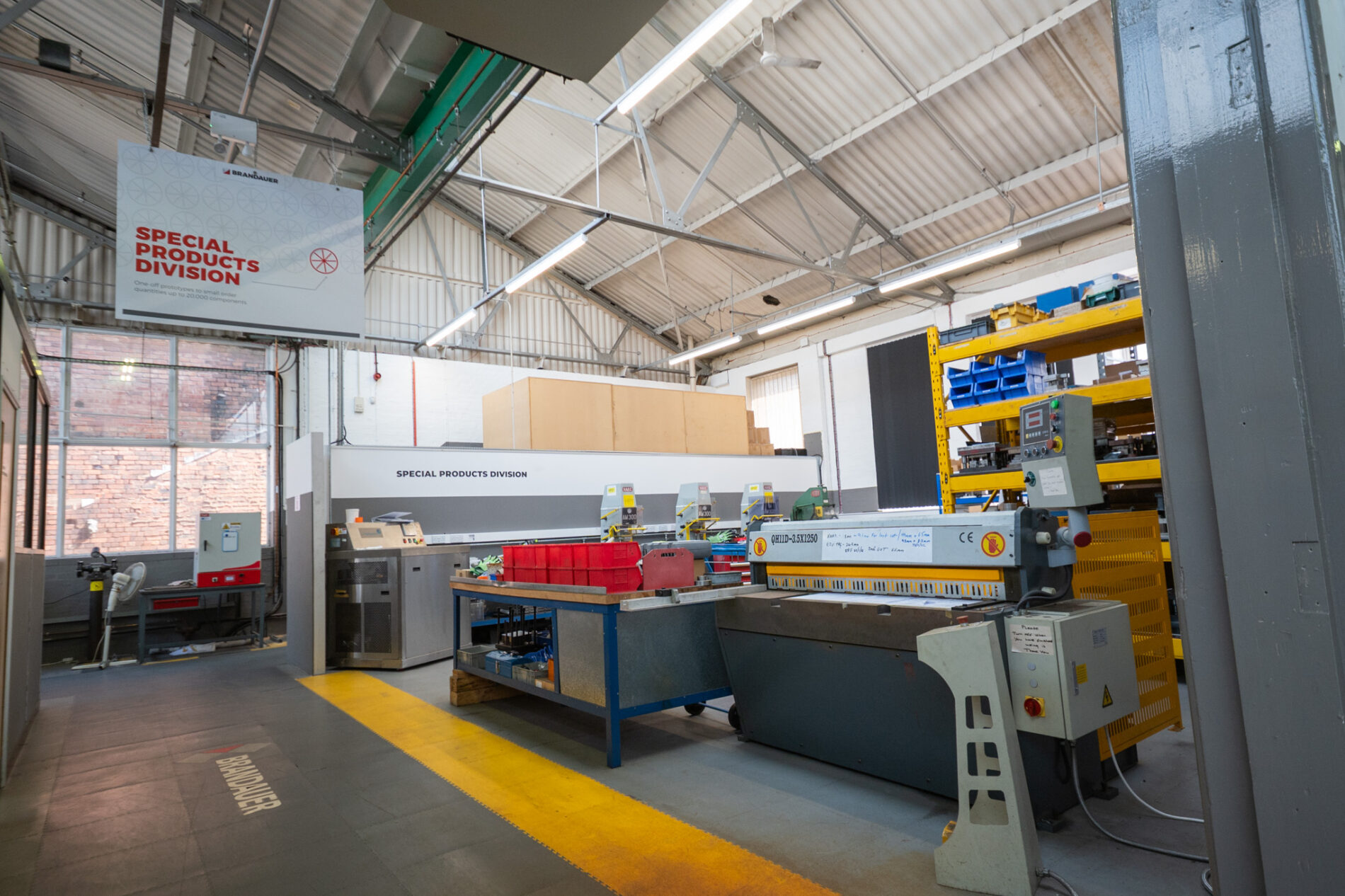
Our Special Products Division (SPD) is designed to aid in the development of parts and products, not only providing you with precision accurate low volume sample runs, but also assisting you with the development of your product.
We also have WEDM capabilities. Wire Electrical Discharge Machining (WEDM) utilises a fine wire to generate electrical discharges that break down the material. WEDM is perfect when accuracy is a non-negotiable, allowing for intricate shapes that would be extremely difficult to achieve with conventional machining. Our WEDM machines can work within a 1-micron tolerance; that’s 0.0001cm!
On the other end of the spectrum, our high-volume precision metal stamping processes have been a key element of the business – some of our presses can run up to over 1,400 stamps per minute (SPM). We run everything in-house for our customers, from the tool maintenance to the manufacturing of the part itself, meaning you don’t have to worry about machine maintenance and factory upkeep. Our customers just order the parts, and we will take care of the rest!
Tooling – how does this link to metal stamping?
During this blog post, you will have read a lot about tooling. But what exactly is tooling, and how does it link to metal stamping?
Tooling – or a tool – is a key part of the metal stamping process. It is the element of the press machine that allows the product to me made and is bespoke to each customer and part. Tool design and development is a crucial part to ensure you get the product to the desired specifications. It’s the element that enables manufacturers to mass-produce high quality components at scale.
Without it, you aren’t able to engage with metal stamped components. You can read more about tooling and Brandauer’s capabilities on our tooling blog or webpage.

What are the different types of stamping processes at Brandauer?
Brandauer cover all bases when delivering stamping processes. From low-volume prototyping to high-volume automated manufacturing processes, we cover it all.
But what stage is best for a specific part, volume and manufacturing stage?
Low volume – prototyping stage
Low-volume and prototyping manufacturing is for anyone looking for one-off production runs up to 20,000 ppa (parts per annum). This process includes processes such as laser cut blanks, WEDM blanks, singe stage tooling, or forming through a single-stage morning machine.
This process is a low output/run rate. It lends perfectly to small production runs or parts at the very earliest stage of their development lifecycle.
Generally, low volume piece part costs will be higher, but initial tooling investment will be kept to less than £5,000. Whereas high volume applications will drive the need for a higher initial tool investment (up to £150,000) but much lower piece part costs.
Brandauer’s three-stage tooling standards:
For anything above 20,000 ppa, we begin to look at Brandauer’s three-stage tooling process. These tools change depending on the customers’ requirements, part and volume but overall, this is what you can expect from those stages:
Standard fixed tooling
This is our most basic tooling offering. It comes with:
- Die set precision guidance
- Typically, this tool will use fixed location punches
- A material thickness of > 0.5mm
Precision tooling
This is our next level in tooling, offering greater precision and customisation. It comes with:
- Full length die set (top and bottom bolster) with large precision guidance elements
- Fixed internal elements with individual precision guidance elements
- Punches and dies cut to +/-0.001mm
- Material thickness capabilities of 0.05mm-1.0mm
Fully modular tooling
Our highest level of tool offerings, this offering is perfect for automated manufacturing runs and parts requiring a continuous, high-volume production line. In its most simple form, it’s a tool made up of smaller tools, allowing for customisation and continuous running through general tool maintenance periods. The offering from this solution includes:
- Full length die set (top and bottom bolster) with large precision guidance elements
- Internal modules with individual precision guidance elements
- Punches and dies cut to +/-0.001mm
- Material thickness capabilities of 0.05mm-1.0mm
- Suitable for ‘in press’ change over
- Reduced changed over time (SMED)
Full automation
The final stage of the stamping processes is a fully automated production line. These are for continuous, high-volume part requirements (circa 1 million+ parts per week). These production lines don’t just include the presses; they include re-reeling, stacking, cleaning, inspection and packing, potentially all in one production line!
Further down this article we delve more in-depth into one of Brandauer’s automated manufacturing lines, how it benefits us and more importantly, the customer!
What are the types of power press machines at Brandauer?
Whilst press machines all have a similar job to do, they all have separate advantages and disadvantages. They can usually be separated into two different categories.
Low volume stamping presses
Single stage fly presses, single stage Hare presses and Seyi presses are all catered towards the low volume/prototyping manufacturing runs. They’re perfect for manufacturing runs up to 20,000 part per annum and are seen mostly within our Special Products Division (SPD). They benefit from handling simple tooling capabilities, meaning a lower setup cost compared to higher-volume presses, but come with lower run rates and output, along with slightly less precision on each stamped part.

High volume and automation stamping presses
Yamada and Bruderer presses are catered to the high-volume, automated manufacturing runs. These presses specialise in high volume, thin gauge precision stamping with very high potential running speeds and high accuracy. Any job above 20,000 ppa is ideal for these presses, but they really showcase their value in manufacturing runs requiring millions of parts a week.

What industries does metal stamping commonly serve?
One of the amazing things about the precision metal stamping industry is there is no dedicated industry. Any company in any industry that requires a small, thin gauge stamped metal part could use precision metal stamping as a solution.
With that being said, here are a list of common industries that precision metal stamping providers (most including Brandauer) are supplying to. The industries below are defined by the industry name and current UK Standard Industry Classification (SIC code).
| Automotive and transportation – SIC = 3714 | The automotive industry is a big sector for Brandauer and the metal stamping sector. We supply various components for this sector ranging from connectors in rear view mirrors, tire pressure sensors, power steering columns, and even the motors that drive electric vehicles. |
| Electrical components – SIC = 3571, 3679 | Electronics is a vast sector and demands ultra-precise components for applications such as PCD boards. An example of Brandauer’s work within this sector is press-fit pins (EloPin®) that enable a solderless connection within a PCD board. |
| Aerospace and defence: Aircraft – SIC = 3721 Guided missiles and space vehicles – SIC = 3769 | With the defence sector having a huge injection of funding over the next 5+ years, it has never been a better time for precision manufacturers. With constant innovation, there is always something for metal stamping manufacturers to create for the defence sector. |
| Motors and generators – SIC = 3621 | Within the automotive industry specifically, calls for electrification has seen rapid growth. Brandauer has been right in the mix of development with our motor lamination solutions. It doesn’t stop there though. Any electric motor that requires a lamination stack lends itself perfectly into metal stamping, even for tiny drones! |
| White goods/home appliances – SIC = 3639 | Any of the white goods that you find in your home, you will find parts that can be precision stamped. An example of this: Brandauer produces 90% of the world’s kettle connectors! |
| Telephone and telegraph apparatus (telecoms) – SIC = 3661 | Metal stamping in telecoms enables the production of precise components essential for modern communication systems. Brandauer’s work in this sector includes ethernet connector pins and EMC shielding. |
| Plumbing – SIC = 46740 | Plumbing was originally an industry that Brandauer wasn’t expecting to get into, but it’s now one of our biggest industries! We supply grab rings for various push-fit plumbing suppliers. This sector is a testament to how diverse the components within the metal stamping industry can be! |
Is metal stamping right for you?
You’ve heard all about the buzzwords, and the many industries that metal stamping plays a part in. But is metal stamping the right solution for your company? Precision metal stamping offers a vast number of advantages that make it a must-have solution for companies in a wide range of industries requiring thin-gauge, precision stamped components.
Benefits
High precision
Metal stamping is a manufacturing process that holds precision at its very core. It’s a repeatable process that guarantees little to no variation between parts, ensuring peace of mind for the customer. To take this one step further, Brandauer has a dedicated in-house quality team that meticulously inspects parts from every production run to ensure the tightest of tolerances and all customer specifications have been met.
High efficiency
Especially in high volume production runs, metal stamping can be a highly efficient solution. We work with all our customers to create a custom tool that ensures maximum output and efficiency from the press machine. An example of this is stamping multiple components within one strike of the press through dedicated tool designing. This efficiency is the perfect solution for fast manufacturing, whilst still maintaining top quality within every part.
Low cost
After initial setup cost and tooling investment, metal stamping is a highly economical method of production. Using automated manufacturing methods, the cost per part will be dramatically reduced compared to other methods of manufacturing. This enables our customers to always stay competitive within their market.
High volume perfection
As detailed above, metal stamping is perfectly set-up for continuous, high-volume production runs. There are little costs to run the tool once setup is complete, coupling this with a reduction of downtime during the manufacturing process. It lends itself perfectly to high-volume metal stamping production lines.
Versatility in part size and complexity
There really is no part too complex for metal stamping! Metal stamping offers the perfect solution to parts that are tricky to manufacture. With bespoke tooling and design, any part is possible to design and manufacture.
Added value
Metal stamping isn’t just about producing parts; it’s about innovation and collaboration, from the earliest design stages, right through to second or third iterations of a product. We work closely with our customers and various suppliers to optimise their product for performance and cost effectiveness. Our Design for Manufacturing (DFM) service ensures that components are designed to the exact specifications required, along with working closely with individuals on the project to provide innovative solutions that could ultimately better the product/manufacturing processes.
We also provide in-house tooling design, manufacture and development, plus a range of secondary processes such as de-burring, plating, degreasing and cleaning (for medical equipment).
Brandauer works with you from conception to completion.
Things to consider
Setup cost and low volume stamping
When deciding if your component requires metal stamping as a solution, a big contributing factor is setup cost. Precision metal stamping requires bespoke tools and that isn’t a small expense to prepare.
We believe in scaling and managing the profile of this investment. From conceptual advice through to prototyping a one-off, then to a small batch on single stage tooling, and finally a semi-automated solution with a fully automated solution to be added on as volume ramps up to peak levels. This means the spend can be staged whilst proving out each stage of your bespoke design.
People who are looking for small annual quantities or a prototyping solution for their metal parts can refer to other methods such as laser cutting and WEDM. Both of those solutions we offer at Brandauer and are tailored for lower volume manufacturing runs without compromise on precision.
If you are unsure on what the right solution is for you, please get in touch with our expert team, who will advise you on what is the most efficient solution for you is!
Case study: razor blade stamping
Brandauer currently has three fully automated manufacturing lines that create razor blade housing for two big manufacturers. They are a perfect example of Brandauer’s fully modular, automated production lines. So, how did Brandauer come to bring this manufacturing process in-house?
Process
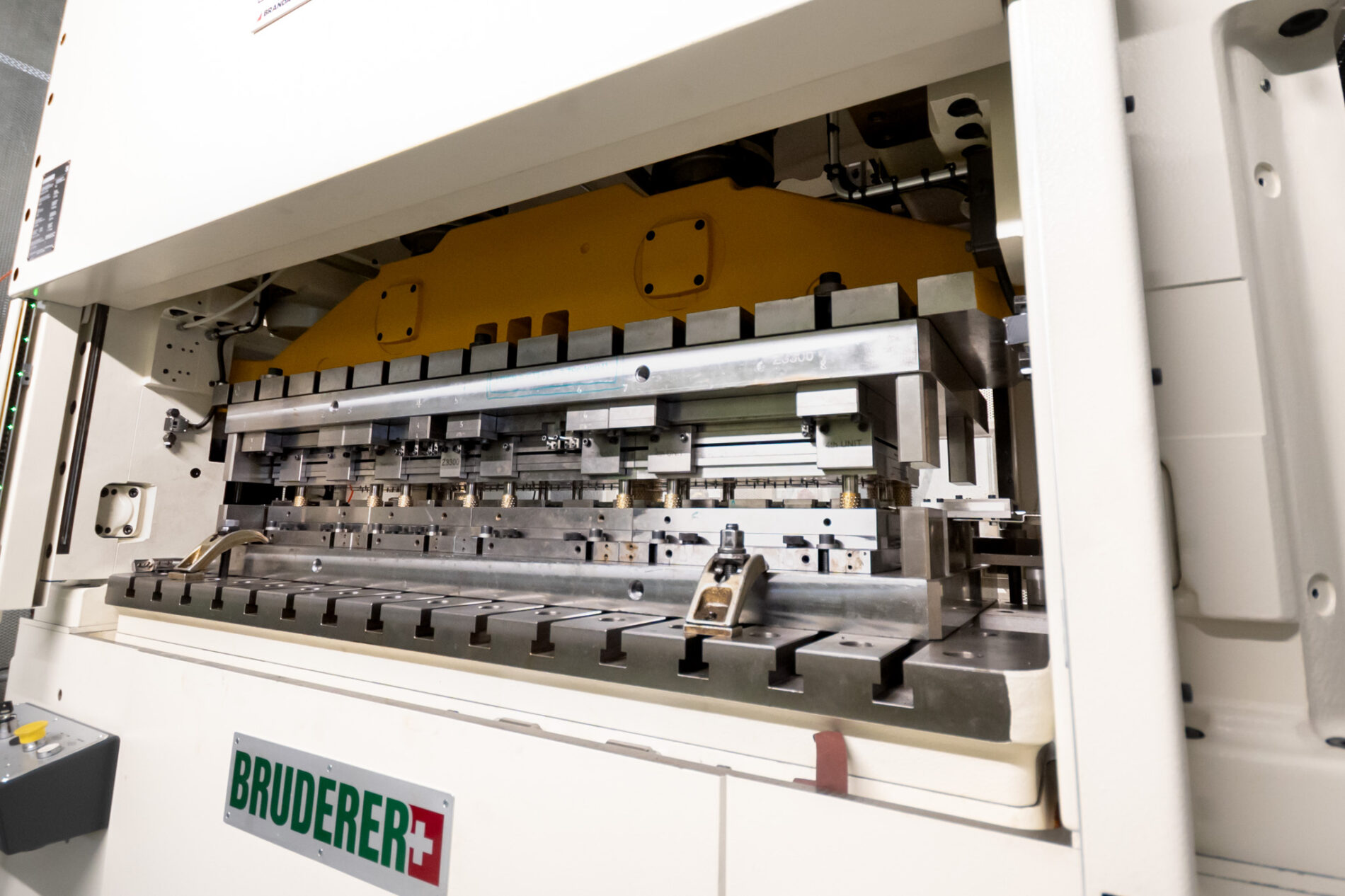
The process begins with a horizontal de-coiler, combined with a levelling head feeding the raw material into the 51 tonne Bruderer press.
After this, a modular tool is stamped down at 300-400 spm (strokes per minute) to create a 36-stage progression strip. After each stamp, more of the razor blade housing becomes clear and after those 36 stamps of the press, the razor blade housing is complete!
After the product emerges from the press, the stamped strip is fed into an ultrasonic cleaning line which cleans and degreases the product to a dyne level of 42, this stage occurs straight after the part is stamped.
Finally, the product is packaged. The reel is fed onto an automatic 4-reel recoiling machine, after each reel is filled, it will automatically traverse onto the next reel, so production downtime and operators labour are minimal. For each reel, two sample strips are automatically cut. One for our dedicated in-house quality control team, and one for the customer to perform their own inspections.
These production lines produce up to 1.4 million parts per line, per week. Brandauer currently has three of these production lines up and running.



Modular tooling capabilities
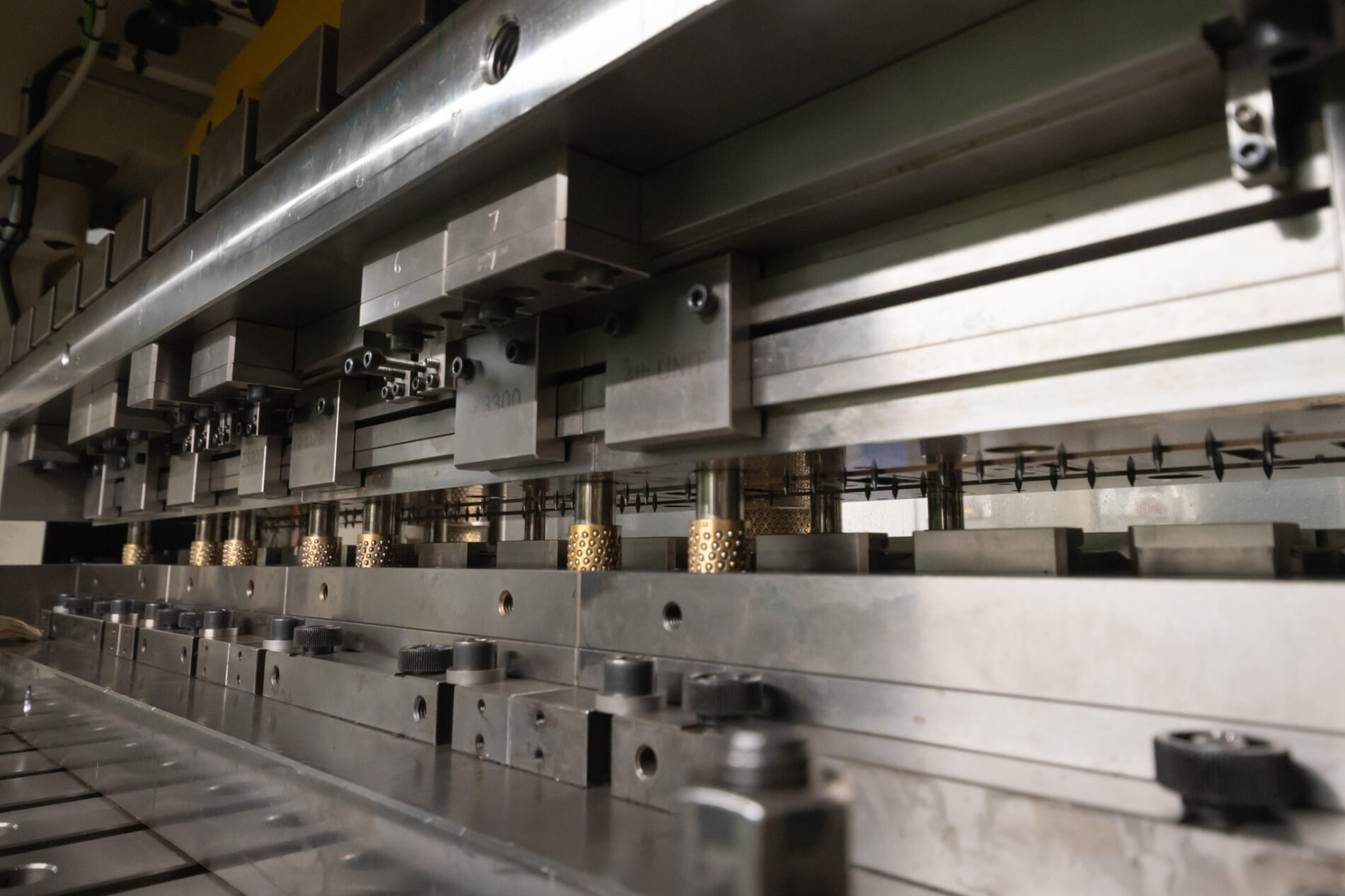
These projects are a perfect example of our modular tooling capabilities. These production lines have a 4-module tooling system with around 25 adjusters, which enables fine tuning to all the dimensions during production, based on statistical process controls in place.
Why modular tooling?
Modular tools are perfect for continuous, high volume production lines. To put it simply, they ensure minimal downtime during production. They allow flexibility if something was to go wrong. If something within the tool breaks and needs repairing, a modular tool allows part of the tool to be removed as opposed to the entire tool. This drastically reduces time taken to repair, as tools are heavy and extracting the whole tool takes additional time.
Further to this, you can acquire repeats of the same tools within the modular system. This means whilst one is being repaired/serviced, the module can be replaced by a spare section. This means production doesn’t have to halt, leading to considerably less downtime.
Why not manufacture in-house?
One of the biggest questions surrounding these automated manufacturing processes is “why not develop one in-house?”
Whilst yes, it is true that the part cost would be reduced, it is still more cost effective to set up a bespoke production line with a specialist stamping company. Some of the reasons are:
- No factory space required – These production lines take up space, which the customer will need to source, rent, or even purchase. Brandauer already has the space available to set up these production lines.
- Labour cost – A company would have to hire a full team across different professions to fulfil all the required roles needed to maintain a production line. A company would need a press setter/operator, quality control team, tool specialists and more. At Brandauer, we already have skilled team members across all sectors to ensure perfect quality at all stages of production.
- Tool maintenance – A tool may break or require scheduled servicing. You would need a dedicated in-house tool room to ensure the upkeep of your tool, costing you in space and labour. Brandauer covers all this; we have two dedicated toolrooms across two sites with highly skilled professionals populating them.
- Inspection – As discussed, metal stamping requires the tightest of tolerances. After each production run, your metal parts will have to be meticulously inspected, requiring full metrology inspection capabilities. This takes up space, time and labour costs. Brandauer has a fully dedicated quality control room which caters to all inspection requirements.
- Supply chain leverage – Brandauer purchases over 1,000 tonnes of precision strip material from across the globe. It’s taken us over 160 years to develop our knowledge and relationships to ensure we source the best value, quality and delivery times from this specialist supply chain; in-house manufacturers will lose this advantage entirely.
Collaboration is key
One major element that is overlooked in metal stamping is industry collaboration. True success when engaging with metal stamped components comes from collaboration from the customer, manufacturer, suppliers, and partners across the whole supply chain. It creates a better experience for the customer, a better outputted product, and finally a smoother and more streamlined process for both customer and manufacturer.
An example of Brandauer’s collaboration is our development of the plumbing grab ring. Our customers came to us for further development of an existing product we were already manufacturing. After an extended process of re-designing both product and tool, we increased their output from 390ppm to 1,500ppm (parts per minute), adding value for all parties involved.
Other examples of where Brandauer champions collaboration is:
Supply chain collaboration
Brandauer works with companies across the supply chain to enhance a customer’s product. This could be from the materials supplier all the way to finishing and plating companies. Having these strong relationships with other companies allows Brandauer to be a “one stop shop” for all our customers; they don’t have to waste time searching or comparing quotes. We all work together to deliver the best product possible.
Make UK and membership organisations
We are proud members of Make UK, a company that champions growth and innovation for manufactures. We have worked closely with them for many years, so much so that our CEO Rowan Crozier MBE is the Chair of the National Advisory Board. This relationship thrives on driving the manufacturing sector forward and ensuring all customers benefit from this.
Brandauer is also part of other key membership groups, which aid in expanding our knowledge on various industries and bettering our experience for the customer. We are proud members of the CBM Group, MAN Group and so much more.
Single project collaborations and consulting
Brandauer has done multiple projects that champion R&D through grant funding. One current standout project is with Ford Motor Company, who we are working incredibly close with to develop a bespoke stamped motor laminations production line for their future range of EVs.
This collaboration and consulting are a huge part of Brandauer’s mission, providing consulting works to current and new customers to help them develop their products/in-house solutions.
Academic collaboration
Brandauer has always championed young people through the apprenticeship programme – they are the future of engineering after all! It is hugely important to onboard as many young people into the manufacturing industry as possible.
An example of this collaboration outside of our apprenticeship programme is the MAN Group Design and Make Challenge. In 2024, we helped showcase the best of young engineers in a one day, one brief challenge with a number of different outcomes. We are returning in 2025 and look forward to aid in building the next generation of engineers!

Conclusion
Precision metal stamping lends itself as a manufacturing solution that combines efficiency, scalability and innovation, but most importantly, accuracy. It doesn’t matter if it’s a low-volume prototyping product for a start-up company, or a complex manufacturing process creating millions of parts a year for an industry leading supplier. If you need a stamped, small metal part, metal stamping is the solution for you!
The benefits are clear – high precision, repeatability, very low costs (after setup fees), efficiency and speed. Further from this though is the collaboration, DFM and innovation across the whole supply chain, which is what really makes precision metal stamping stand out as a solution.
At Brandauer, we make the impossible possible by supplying the little parts that make the big ones work!


